The First Woman (Part II)

Tuesday 06/29/10

Ms. Ederle returned from England to both cheers and jeers. Much of the reaction split along the schism that prevailed in 1925 related to ideas of a woman’s proper place in the world. The cheers celebrated Trudy Ederle’s massive effort as a testimony to women’s athletic potential and an example of the true grit of the female gender. The jeers lamented the coarsening of the female ideal, the threat that athletic endeavour presented to potential motherhood, and the prospect of an emasculated race of men. And the simmering tiff with Jabez Wolffe fanned the negative flames. In her influential monthly column in the Washington Post, Dorothy Greene wrote, “the whole matter is not worth a fiftieth of the publicity which it has received, and we are tempted to agree that ‘woman’s place, though it may not be in the home, is certainly not in the English Channel.’”

The swimmer, though still young, was no longer a child. The WSA had shaved a year off of Ms. Ederle’s age, but she was actually nineteen and ready to strike out on her own. Helen Wainwright once again led the way. She accepted an offer to be a spokesperson for American Tobacco Company. She appeared in a magazine ad proclaiming, “We swimmers have to keep in strict training. When I first got started a veteran swimmer advised me that I could smoke Lucky Strikes without affecting my wind or throat. I tried them and found he was right. They’re great! They have never affected my throat and they taste fine.”

Like Ms. Wainwright, Trudy Ederle didn’t smoke. Unlike Ms. Wainwright, she refused to endorse any product she wouldn’t use. Still, the lure of independence offered by turning professional beckoned and she knew the WSA was disinclined to sponsor another Channel effort. Forgoing amateur status, she and several of her compatriots, including Helen Wainwright, took positions as iconic swim instructors at large hotels in Florida. And, a motoring enthusiast, Ms. Ederle found a product she could endorse—the Reo Roadster. She was well on her way to financing another attempt at the English Channel on her own.

The true financial breakthrough came from the newspaper industry. It was becoming obvious to publishers that stories which lent themselves to serialization sold papers. The Scripps-Howard chain had already snatched up Lillian Cannon with exclusive rights to the story of her coming attempt to swim the English Channel in the summer of 1926. Joseph Medill Patterson of the Chicago Tribune-Daily News immediately did the same with Trudy Ederle. According to Gavin Mortimer in The Great Swim, “On May 29 Ederle, accompanied by her father, signed a deal with Patterson’s organization. She would write regular dispatches from France and Patterson would pay her $5,000 with an additional $2,500 if she was successful.” Joe Patterson sent Julia Harpman and her husband, Westbrook Pegler along to ghost-write the dispatches and to protect the newspapers’ exclusive.

For this attempt, Ms. Ederle hand-picked a support team in which she had complete confidence—her father Henry and her sister Margaret. Henry Ederle provided a loan and helped negotiate a contract with Bill Burgess for ten thousand francs including a retainer to guarantee that he train Trudy and no one else. Margaret helped her design a new pair of eye goggles that they hoped would work better than those the year before. Rounding out the team, Joe Patterson hired Joe Corthes and the tug Alsace to provide escort exclusively to Ms. Ederle until she achieved her goal. Mr. Patterson considered the cost of three hundred francs per hour a small price to ensure that no other Channel swimmer had access to the vessel.

For this iteration, Ms. Ederle chose to make home base in France. On June 10, 1926, she and her entourage checked into the small Hotel du Phare in the little village of Cape Gris-Nez. This was no resort. It lacked electricity and running water. According to Tim Dahlberg in America’s Girl, “If someone insisted on a bath—which seldom happened—Mrs. Blondiau and the chambermaid would heat water in huge iron vessels on the kitchen range and carry them upstairs to the tub on the second floor.”

On reaching France, the first order of business was to confront Bill Burgess for violating his contract and agreeing to coach Lillian Cannon as well. Gavin Mortimer relates, “Burgess apologized and explained that … Cannon’s newspaper had paid him twenty thousand francs, and what with the collapse of the French economy because of its war debt to America, he needed the money to prop up his garage business. Of course, if Gertrude’s newspaper were to match what Cannon was paying him, he would be delighted to coach only her.” Eventually, Ms. Ederle grimly agreed and laid down her own set of rules. She insisted that he not try to convince her to use the breaststroke, that he not try to interfere with her stroke rate, and that he absolutely had no authority to pull her from the Channel unless she, herself, requested.

About this time, Jabez Wolffe was looking for work. The public tit-for-tat with Gertrude Ederle had soured his reputation and none of the women aspirants cared to contract with him as a coach. He had heard of an American swimmer named Clarabelle Barrett. She was renown not only for her open water swimming prowess, but also for her size. She was six feet two inches tall and weighed two hundred and twenty pounds. Rumour suggested that she had sailed from New York on July 3, but three weeks later she had yet to appear at Cape Gris-Nez. Lacking newspaper or other financial support, she was conducting her undertaking on a shoestring. She had taken quarters in Dover and planned to swim from England to France. This left Mr. Wolffe fruitlessly prowling the environs of Cape Gris-Nez searching for large women on the chance he might meet Ms. Barrett and offer his services.

The weather and temperature combined to thwart most attempts at swimming the Channel until late in the season. Finally, on August 1, Clarabelle Barrett began her assault from Dover. The New York Times, thanks to its London-based correspondent, Alec Rutherford had the scoop. As Gavin Mortimer says, “It was a tale of indomitable resolution in the face of relentless adversity, a story guaranteed to stir the hearts of Americans.” As so many before, she came excruciatingly close to her goal before fog and tide beset her. Nearly cleaved by a passing steamer in the fog, she finally gave up after twenty-one hours and forty-five minutes.

News of Ms. Barrett’s near success spurred Trudy Ederle to action. On August 6, she entered the water in France covered in three layers of olive oil, lanolin, lard and vaseline until she looked like a “basted chicken.” She was wearing the goggles she and her sister had created which were sealed the night before with a serendipitous amount of candle wax. She was also wearing a shocking two-piece bathing suit, designed and sewed by her sister, to eliminate the horrible chafing associated with women’s swimsuits of the day.

Onboard the accompanying Alsace were Henry and Meg Ederle, Ishaq Helvi, and John Hayward of the London Daily Sketch. Mr. Hayward traveled in his capacity as the official British witness. Julia Harpman allowed no other reporters on the tug. As told by Gavin Mortimer, the remaining stranded newsmen were furious. They understood that, “She was within her rights to protect her paper’s exclusive, that they understood as fellow reporters, but she had intentionally deceived them by allowing them to believe they would be welcome on the official escort tug. Now, at the eleventh hour, she was marooning them on the beach and sailing away like some eighteenth-century pirate.”

Three hours later, the beached reporters had caught up with the swimmer as she made good progress in the calm sea. They had cleverly seized on the realization that Lillian Cannon was not swimming that day. Ms. Cannon allowed them to borrow her chartered vessel, La Morinie, and sailed with them to watch Ms. Ederle conduct her swim.

By mid-morning, the weather started to turn. The wind began to blow from the southwest and the waves began to get rougher. Bill Burgess began to worry. Glenn Stout in Young Woman and the Sea records that, “He thought now of the packet he had stashed in the pilothouse, the papers he had drawn up. Burgess had been afraid that the weather would turn and that he might have to stop the swim and take Trudy out of the water, but all he had heard for the last two months, from Trudy and Meg and Henry Ederle, was that once Trudy started to swim, she would not stop, and no one, absolutely no one, was to touch her and take her from the water, no matter what, unless she called for help herself.” The papers were a release for Henry Ederle to sign absolving Mr. Burgess of responsibility.

As they approached the Goodwin Sands, Bill Burgess and Joe Corthes, the tug pilot began to fear for the safety of both the swimmer and the boat. They called Mr. Ederle into the pilothouse and explained that the responsible course was to return to France. The alternative was to swim into the current for a time to circumnavigate the sandy barrier, but the current was too strong, the wind too stiff, the waves too tall, and the light was beginning to fail. Henry Ederle chose to keep going. His daughter was swimming strongly and even seemed to be enjoying herself. He was not going to thwart her wishes. With a snort, he signed the release.

This sparked a loud argument among the seasick passengers. In the confusion, someone whose identity is lost to history leaned over the rail and shouted, “Come on out, girl! Come on out!” Trudy Ederle famously rolled on her back and shouted back, “What for?” Effortlessly, she had created a catch phrase to spark the imagination and inspire Americans for some time to come.

As Glenn Stout writes, “In an instant the unconquerable Channel was subdued, and the weather, while still atrocious, didn’t matter anymore. With each stroke of her arms and kick of her legs Trudy was taming the Channel. There wasn’t any question about it, not any more. Trudy wasn’t coming out of the water, and if she didn’t come out of the water, she was not going to fail.”

Finally at 9:40p, she walked out of the water onto a Kingsdown Beach that was alight with the bonfires and flares of the people assembled to greet her. She was the sixth person and the first woman to have swum the English Channel. She also owned the record. She had bested Enrico Tiraboschi’s time by almost two hours.

After visiting her grandmother in Bissingen, Germany, she and her family returned to New York City to a ticker tape parade. The incessant press of gargantuan crowds and whirlwind tour of events took their toll. She broke down in exhaustion and rested for a day before returning to her rigorous schedule of luncheons and meetings.

Before her manager could lock down the various lucrative offers that flowed her way, Mille Gade Corson became the second woman to successfully swim the English Channel. Although Ms. Corson was one hour slower, she was a mother of two children. Shortly after this, Arnst Vierkotter set a new crossing record of twelve hours and forty minutes.  The pile of offers meant for Ms. Ederle were withdrawn and replaced with smaller ones.

Still, Trudy Ederle made a decent living capitalizing on the fame of her historic conquest of the English Channel. Later in life, she taught deaf children to swim. She died at the age of ninety-seven in New Jersey having never married—her one opportunity probably sabotaged by deafness. Before she died, she told a reporter, “I have no complaints. I am comfortable and satisfied. I am not a person who reaches for the moon as long as I have the stars.”

The First Woman (Part I)

Monday 06/21/10

Depending on the historical source, Henry Ederle had nineteen or twenty-one brothers and sisters in Bissingen, Germany. Seeking more opportunity in 1892, he immigrated to New York City at the age of sixteen and found work as a delivery boy in a small butcher shop on the Upper West Side. He certainly embodied the classic immigrant success story. Twenty-two years later, he owned a thriving butcher shop of his own, dabbled in investments, and kept a summer cottage in the Highlands in New Jersey. It was here, at a pier in Sandy Hook Bay, that Mr. Ederle taught his three children to swim.

In 1915, most swim instruction was exceptionally primitive. Mr. Ederle’s innovation was to apply his skills learned wrapping meat at the butcher counter to create a harness out of cotton clothesline. Trussing his youngest daughter, Gertrude, he strolled onto the Patten Line Pier near their home in the Highlands and spooled out the line below. Snugging up the rope, he encouraged “Trudy” to enter the water from the beach. The clothesline acted like training wheels on a bicycle. Within minutes, Trudy was performing a vigorous, thrashing dog paddle without assistance from her dad. She was in heaven. As reported by Glenn Stout in Young Woman and the Sea, she would later say, “To me, the sea is like a person—like a child that I’ve known a long time. It sounds crazy, I know, but when I swim in the sea I talk to it. I never feel alone when I’m out there.”

Perhaps part of her affinity for being immersed in the water sprang from her diminished hearing. When she was five years old, an attack of measles left her with an ear infection and hearing loss. In noisy settings with a gabble of conversations, she became confused and distracted. Although she was outgoing and lively with her family and friends, around strangers she appeared shy. She regularly retreated to her private world through swimming and reading—spending hours in the open water at the Highlands or burying herself in dime novels of the day.

In one of several fortunate coincidences, 1917 was the year that Charlotte Epstein created the Women’s Swimming Association in New York City. Trudy’s mother, Gertrud (spelled without the trailing “e”), immediately recognized the opportunity and signed up all three of her daughters. Ms. Epstein had cleverly positioned the WSA as an ancillary and subservient arm of the Amateur Athletic Union. According to Tim Dahlberg in America’s Girl, “Epstein got the AAU not only to accept women’s swimming as a sport but to allow swimmers to wear suits they could compete in.... American women would compete in swimming in the 1920 Olympics for the first time, and they would do it mostly in the black silk racing suits of the WSA.”

In another fortunate coincidence, Louis de Breda Handley was the swim coach for the WSA. An Italian immigrant and champion swimmer in his own right, Mr. Handley co-invented the “American crawl” stroke. Known today simply as “freestyle,” this is the stroke he taught to swimmers at the WSA. Far superior to the popular “trudgen” and “Australian crawl” strokes, the WSA competitors used the American crawl to dominate the 1920 Olympic swimming trials and then the Olympic swim events themselves.

Practicing three times a week at the WSA pool in the winter, Trudy Ederle was mastering the new crawl stroke but showing little interest in competition. It was her sister, Margaret, who registered her for a three-and-a-half mile open water swim from Manhattan Beach to Brighton Beach in 1922. Organized by Joseph P. Day, the swim featured the WSA Olympic swimming stars as well as Hilda James of England. The Liverpool native carried the reputation as Europe’s greatest woman swimmer. The stellar quality of the competition made no impression on Trudy Ederle. Now sixteen years old and perfectly content in open water given her Highlands experience, she finished nearly a minute ahead of her closest competitor and burst upon the swiming scene. With her youth and unforced charm and modesty, she quickly became the new face of the WSA.

By 1924, Gertrude Ederle and Johnny Weissmuller were the stars of the U.S. Olympic swim team. Although she won three medals, Ms. Ederle’s performance along with the rest of the women’s contingent suffered from mismanagement of the team logistics in Paris. She nevertheless returned to great acclamation, but any thrill she had ever mustered for pool competition waned dramatically.

Charlotte Epstein of the WSA had new plans, though. Given the lull between Olympic years, she saw an opportunity in the English Channel to keep the WSA in the newspaper headlines and attract donors. No woman had yet swum the Channel and she convinced the WSA board to authorize a $5,000 budget for the project.  They assigned Ms. Epstein to make all the arrangements and accompany the swimmer in the attempt.

Fifty years after Matthew Webb swam the English Channel, only four other men had replicated his feat. It wasn’t for lack of trying. The Dover Express, considered the doyen of Channel swimming at the time, estimated that the number of attempts since 1875 exceeded 1,000. Jabez Wolffe single-handedly contributed at least twenty-two and maybe as many as forty failed attempts to this number without a single success.

In 1911, Bill Burgess finally became the second man to swim the English Channel after several failed attempts of his own. It took him almost an hour longer than Captain Webb. Shortly after Mr. Burgess’ success, the Great War threw a wrench into the works of further efforts for several years. After the war; after the mines were cleared; and after the world economy finally began to rebound, 1923 represented a break-through year for Channel crossings. Three men more than doubled the ranks of successful swimmers. One of them, Enrico Tiraboschi, finally bettered Matthew Webb’s time by more than four hours with a time of sixteen hours and thirty-three minutes. He set the new mark swimming from France to England for the first time, a route widely deemed to be much easier than starting in Dover given the more favourable landing conditions.

Charlotte Epstein and Louis Handley believed that they had a swimmer who could not only become the first woman. They believed that she could best the time of Mr. Tiraboschi by as much as two hours. They believed this woman was Helen Wainwright. Biographer Glenn Stout muses that, “this was a measure of just how far Trudy’s star had fallen, for Wainwright, despite all her talent, didn’t have nearly as much experience as Trudy in open water.”

Fate intervened when Ms. Wainwright slipped while exiting a trolley and tore a muscle in her thigh. Once again, Margaret Ederle immediately began a campaign to convince her younger sister to take up the challenge. Trudy Ederle was the obvious choice to the press and the coaches to provide a backup. The WSA board authorized additional funds to take two swimmers.

While making the arrangements, Ms. Epstein had the choice between two well-credentialed coaches for the endeavour. Jabez Wolffe was based in England and could certainly boast vast, if unsuccessful, experience. Bill Burgess, the other obvious choice given his success in 1911, was based in France. Ms. Epstein believed that the best course of action was to train in England and then attempt the crossing from France. She went with Mr. Wolffe.

Before leaving for England, Ms. Wainwright slipped again and reinjured her thigh leaving Trudy Ederle to travel alone with her chaperone, Elsie Viets. Louis Handley had carefully structured Ms. Ederle’s training agenda both in America and during her preparation in England. With the help of Margaret Ederle, he had convinced the young woman that she was prepared to succeed and filled her with confidence. This set the stage for a dramatic showdown with the cantankerous Mr. Wolffe.

Although he was Jewish, Jabez Wolffe had the strict, thundering style of his fellow Scot, the pinched and decidedly protestant John Knox. Mr. Wolffe continually berated his young charge and constantly drilled her on the dangers of the English Channel. He even introduced the notion of man-eating sharks. He berated her stroke and recommended the breast stroke. He lambasted her stroke rate of twenty-eight per minute and suggested eighteen or twenty as more suitable for the Channel distance. He tried to interfere with the training schedule Louis Handley had given her. He condemned her effort to teach herself the ukulele outside of training hours as fatuous. He insisted that Ms. Ederle accept deep, vigorous massages to “harden” the muscles and make them immune to fatigue.

With the backing of Ms. Viets, the aspiring Channel swimmer resisted all of these entreaties with the possible exception of being frightened about the potential for sharks. According to Glenn Stout, “to Trudy, Wolffe was ‘all wet.’ … Although Trudy was generally shy, when it came to swimming she knew her stuff and wasn’t afraid to express her opinion.” By the time they moved camp across the Channel to Boulogne, France, the battle lines were deeply drawn.

On August 17, 1925, Ms. Ederle began her attempt from a rocky outcrop at Cap Gris Nez. During the crossing, she and Mr. Wolffe continued to spar. He continually chided her for swimming too fast and insisted that she stop every thirty minutes for chocolate and beef tea. Tim Dahlberg in America’s Girl says, “Trudy would later talk about her distrust of the beef broth and Wolffe’s insistence that she drink it. It gave her a warm, burning sensation, which made her think it might be wine or liquor. Wolffe would tell her it was just juices of genuine beef, but this butcher’s daughter knew what beef and its broth tasted like, and it tasted nothing like this.” Many experts at the time believed that doses of whiskey or brandy helped to warm the blood and stem the effects of cold water. However, Ms. Ederle simply didn’t like alcoholic beverages of any kind and firmly refused Mr. Wolffe’s efforts to get her to imbibe during training. Some historians even allude to the possible addition of opiates or barbiturates.

In any case, Ms. Ederle swam swiftly for close to nine hours to get within six and a half miles of the English coast. Then, in a moment that remains controversial, Jabez Wolffe ordered Ishaq Helvi to “grab her” or some command to that effect. Mr. Helvi was a large, gregarious Egyptian who had become friends with Ms. Ederle during her stay in France. He was a Channel aspirant himself with multiple attempts under his belt. He was in the water acting as a pacer at the time and once he touched Ms. Ederle, the swim was over—her attempt a failure. Although she returned to America a celebrity, the Channel remained unconquered by a woman that year.

The Mental Stuff

Monday 05/31/10

The mystery is solved. Cliff Golding is the Channel swimmer who taught me about the psychological tool for surviving an attack of debilitating doubt in the middle of a long, cold swim. Fortunately for me and the rest of the marathon swimming world, he recently updated his handbook for swimming the English Channel and posted it on the channel swimmers chat site.

According to Swim Trek, "in 1981 Mr. Golding was a twenty-six year old, very contented endurance athlete. Then he took up Channel swimming and ruined his life.” His handbook belongs on the “must read” list for swimmers preparing to attempt a solo English Channel crossing. It covers almost every practical aspect of the swim from boarding to re-boarding the pilot boat. He has graciously permitted republication of this material.

Alison Streeter, MBE, has completed forty-three successful solo crossings of the English Channel, more than any other woman. For this accomplishment, she carries the title, “Queen of the Channel.” Ms. Streeter has famously declared that “Channel swimming is 80% mental, 20% the rest.” In light of this piece of wisdom, I have excerpted the following psychological tips from Mr. Golding’s handbook:

“Now the heavy bit!

There will/might come a stage when you way are out of your comfort zone, having exceeded the longest time previously spent in the water and think the task is now beyond you. Or you might think this early in the swim. Or it might happen when a lot of swimmers hit a rough patch – around the 5-7 hour mark. This is normal. I say again – this is normal!!!!! Oh yes, this is so normal!

I have two hard learnt theories pertaining to Channel swimming. The first is that women are inherently mentally tougher than men! There you go, I’ve said it – and not for the first time! I don’t wish to be too general, but when a man goes to the edge and topples over he can fall into an abyss of despair and stress. If others have witnessed this mental implosion the situation is exacerbated ten fold as far as he is concerned. If a man boos his leg off and calls for his mummy then it can be game over! I never booed or cried for mum in my early days of Channel swimming but I did implode mentally in spectacular fashion and this mental falling apart was, for me, shameful and insurmountable (mad, hey?). Women, on the other hand, are different. Not always, but, in most cases, when a women falls over the edge, she boos her leg off and then gets on with it with a, “So what? Never seen a girl cry before?” defiance.

The shame and insurmountable odds I referred to lead to the second theory which applies to both men and women. I believe we all have secret doors in our heads. When we do long, meaningful swims in training or, ‘on the day’, we can crash headfirst into these secret doors when our task seems beyond us. They are double, triple bolted and have huge mounds of debris in front of them. This debris is not the debris of the swim or the day but of our other, day to day, life. It took me 5 years and 6 Channel attempts in the early nineties (doh!) to realise that I could shift this debris and break down the doors.

The first time I pushed through the ‘secret door’ was one of the most empowering, most enlightening experiences of my life. My whole world, my whole existence, seemed calmer and friendlier. It was then that I realised it was OK to be shit scared, that this gut wrenching paralysis was surmountable. Indeed, instead of fearing fear I saw that it was actually something to acknowledge and embrace and respect. And, guess what? You CAN go beyond your previous limits and succeed - ‘cos, if I did …………!

The reason for this quite revealing section is to tell you that when it hits you (some people deny ever feeling scared or mentally bereft during their Channel swim but I don’t believe a word of it!) let it happen. And don’t be surprised if it hits you early on and more than once. If it does, just move the debris again and open the secret door.

Each swim I do I get hit by the demons again. They don’t announce their arrival, it can be after 1 hour or 6, but once they hit me it’s full on. They burrow and forage and worm their way in, feeding on my fear and trying to get me to quit. And they talk to me!!! 'Go on,' they say. 'The ladder’s just there. Touch it, feel the warmth of a helping hand. We have hot soup and warm clothes and a bed for you to sleep in.' They’re buggers the lot of them. I despise and hate them. Sometimes they gain ground and I have a torrid time but at least I know what to do now.

Be assured, you will be scared - in training, in the lead up and, especially, on the day. Slow or fast, young or old, you will have doubts and wonder what ever inspired you to take this crazy gig. But, crucially, you are not alone. Everyone, to one degree or another, is going through the same angst, I promise. You CAN push through the pain and self doubt. Just unlock the secret door!

When you land it is amazing. Your life will change from that moment – guaranteed. Whatever journey you have taken to get there, and whatever trials and tribulations you encountered on the way, to achieving your dream, you now have the right to call yourself a Channel swimmer. WOW! How cool is that?

WELL DONE! WELL DONE! WELL DONE! WELL DONE! WELL DONE! WELL DONE! WELL DONE! WELL DONE!!!!!!!!!!!!!!!!!!!!”

Five Hour Bay Swim

Monday 05/17/10

The forecast calls for rain. Dark streaks of charcoal smear the western end of an already grey and gloomy sky giving credence to the forecast. We can actually see the sky because it’s 9am and well past daylight. In a departure from routine, we’re not planning to start swimming until 10am. Oddly, a winter that was warmer than usual has been followed by a spring that’s colder than usual. Lately, the water’s been pretty danged chilly in the early morning. We hope to encounter slightly warmer conditions in the middle of the day. Regardless, it promises to be a cold five hour swim in the Bay.

The plan is to use the end of the Dolphin Club dock as a base of operations. Ralph Wenzel and I will swim “mostly coves” and return periodically to the dock for feedings. This way, we avoid the logistics associated with a motorized pilot craft. We also gain the advantage of being able to easily warm the water in the club kitchen for the feedings. Perhaps as important, we’ll be able to involve the entire crew scheduled to assist on the boat in the English Channel.

Lindsay C, Darcy W, and Jackie M will take turns providing kayak pilot coverage for us. That will afford everyone the opportunity to become familiar with the progression of my swim stroke over time. Each crew member will also get a chance to prepare the feedings. Popular conception portrays crossing the English Channel as a long and lonely venture--the isolated swimmer struggling against the dynamic sea. It may be true for some. It’s not true for me. I am fortunate to have a committed and supportive team.

As Ralph and I are undressing in the locker room, we get a report that the water temperature this morning was 51.5 degrees Fahrenheit. The report does nothing to calm our nerves. This swim is the longest either of us has ever attempted. All of us, swimmers and crew, are plagued with various levels of performance anxiety. Forefront in my mind is my failure to complete five “coves of death” a week and a half earlier. I’m tucking the sting of that defeat into my psychological tool bag. Having it there doesn’t relieve the anxiety, however.

Jackie M launches the Sweet Lorraine, the kayak we’ll be using for pilot coverage. She paddles toward the Opening. Ralph and I shake hands, wish one another luck, and wade into the water to follow Ms. M. Our first leg is a trip to Fort Mason and back. The water has warmed slightly from the early morning. Still, the temperature varies between 52 and 54 degrees, depending on current flows and upwellings.

By the time we reach the Opening, we’ve settled into a steady rhythm. When we reach the second pier at Fort Mason, we take a wide turn and head back with the building flood current. With almost six feet of visibility, the water is quite clear. The wind is negligible and the surface is reasonably calm. We’re feeling good. We’ve been swimming for forty-five minutes when we stop at the dock for our first feeding.

Using warm water to mix with the maltodextrin powder is a definite improvement. It doesn’t exactly warm me, but it also doesn’t send an inner chill coursing through my body. In another modification, Lindsay has added a small dose of apple juice to the mix. It cuts the gumminess of the plain mixture and offers a small fructose boost. I try to keep the feeding time to twenty seconds or less and chug down 300 ml with some leaking out the sides of my mouth.

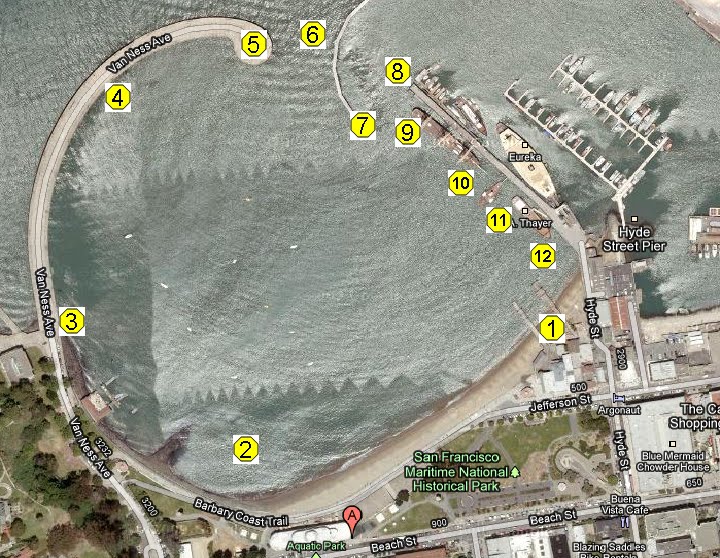
For the second leg, we swim a large, clockwise cove. Stopping again at the dock, we refuel and head back for a counter-clockwise tour of Aquatic Park. As we stroke for the Oprah, Ralph shouts a suggestion that we swim on the east side of Hyde Street Pier. I agree and we thread our way through the piers. Lindsay C is taking her turn in the kayak and sees us disappear behind the Thayer. She didn’t hear our agreement to alter course and spends a few frantic minutes searching for us until she realizes where we went. She meets us at the Alma and escorts us the rest of the way around the cove.

At the next feeding, I’m feeling cold and uncomfortable. With the extra curlicues, we’ve been in the water for almost two hours—longer than my abbreviated swim the fifth of May. I was worried that coming back to the dock regularly would exacerbate the desire to cut the swim short. I was right to be worried about that. For the first time today, I trot out the “la muerta pequeña” tool. It works. I glug down another feeding and we set off for an “outside-inside.”

By now, the flood current is really piping down the side of the breakwater. It’s noticeably rougher water and we shoot east. At the “creakers,” we spin around to face the flood and creep back along the inside of the concrete wall. When we reach the dock again, we’ve been swimming two hours and forty-five minutes. Ralph shouts out loudly, “Over the hill, Larry! We’re over the hill!” The crew members on the pier laugh at the unintentional double entendre as it relates to our progress in this swim and our ages. The best response that I can muster is a bland nod of the head and a widening of the mouth that looks more like a grimace than a smile. I concentrate on feeding as fast as possible and striking out again.

We set out on another clockwise loop around the cove. Just past the Flag, I pull out the “tunnel tool.” The cold has permeated my body and the achy, odious physical sensation is flooding my consciousness. I again imagine looking for the trap door in a dark, icy tunnel. I sling the pile of debris that’s blocking the door out of the way until I break through to a second wind. This is not the first time I’ve used that tool today, but it comes at a fortuitous time.

Darcy W is taking her turn in the kayak. Just past the Goal Posts, she begins screaming. Ralph is also screaming. I don’t realize that the shrieks are coming from my friends. I see what I think are children on the Muni Pier and I think they are warning me away from their fishing lines. It’s not until I see a massive white turbulence three feet in front of me that I realize the alarm signals a swarm of sea lions. They are stealing bait from the fishers on the pier and at one point they have me boxed in a thicket of swarming pinniped flesh. I have just geared down into “tunnel mode” and ignore them. The part of my mind that can still think rational thoughts decides, “What can be done anyway? They’re ten times faster than you. Just keep swimming.”

The sea lions are only interested in the bait, not me. Ralph saw them early enough that he veered into the middle of the cove to avoid them. We rejoin at the Repair and continue stroking. Back at the dock, we feed quickly. In honor of our marine mammal friends, we decide to abandon the counter-clockwise cove in favor of another outside-inside.

After two more loops around the breakwater, we’ve been in the water for slightly more than four and a half hours. Ralph exclaims, “This is it, Larry! Just one more!” I don’t need a tunnel tool. I don’t need a “la muerta pequeña” tool. I can smell the barn and it smells good. We finish with a Flag, Bad Becky, Flag and back to the beach. We shuffle onto the sand after five hours and five minutes.

We spend a long time in the shower. We’re so cold that we’re not really shivering. In the sauna, we compare notes and agree that we’re both hurting. My skin quickly feels seared even though I’m not warm on the inside. I move to a lower bench and that helps some. After dressing, we congratulate one another and make plans to swim again the next Monday.

The rest of the day, I feel out of touch with my body. Lindsay insists that I eat some dinner and I find that I’m hungry and didn’t know it. I nurse part of a single, small martini and look at the Giants on the television. The game barely registers and I go to bed early.

It takes me a little over a week to fully recover. For the six hour swim, we’re absolutely going to find warmer water. That will make a six hour swim seem much easier than what we’ve just endured. The Central Bay is four or five degrees warmer. We’ll probably start at the San Mateo Bridge, swim past AT&T Park, around Treasure Island and back to the Dolphin Club. This will mark the completion of prerequisites for attempting a solo English Channel crossing with the CSA. Given the outcome of this most recent milestone, I’m as confident as I’ve ever been that I’ll be prepared.

La Muerta Pequeña

Wednesday 05/05/10

On May 5, 1862, a seriously out-manned and out-gunned Mexican army soundly defeated the French army at the Battle of Puebla.  While not much celebrated in Mexico, the fifth of May is a big deal in the United States. Accentuating this irony in 2005, the U.S. Congress ordered the President of the United States to observe Cinco de Mayo with appropriate ceremonies and activities. Decades before Congress got into the act, Bill Horgos, a member of some notoriety of first the Dolphin and then the South End clubs, suggested a swimming tribute to the fifth of May. He designed and promoted the aptly named “Five Coves of Death” swim.

The swim begins at the clubs’ beach in Aquatic Park. The clockwise option will take the swimmer to the Flag and then to the Goal Posts. Nothing much death-defying about that. From here, though, the course threads under the length of the Muni Pier, a thin, barnacle and starfish-encrusted pathway between concrete and creosote posts. It continues under the Roundhouse and past the jagged pilings out to the Opening. The swimmer then navigates the surging current squishing in and out through the thin gap at the Jacuzzi. From here, the course takes the swimmer behind the Balclutha, swimming over and under scratchy, barely submerged lines and hoses draped from boat to shore. Swimming behind the Thayer presents a similar and slightly more confining challenge. Emerging from behind the Thayer, the swimmer has a short distance to reach the South End pier. Downing a shot of tequila at the pier completes one “Cove of Death.”

I’d always considered this swim well beyond my meager means and more than a little wacky. Upon deciding to train for the English Chanel, though, I made a mental list of previously unimaginable swims that I wanted to tackle and this one ranked in the top (ahem) five. This year, the South End is hosting two swims—one at 5am and one at 5pm. Ralph Wenzel and I choose 5am.

From home, I zip across the sleeping city a little after 4am and find the coveted four hour parking places across the street from the clubs completely empty. A few South End members are filtering down the street, flickering into and out of the light cast by the streetlamps. Inside the South End clubhouse, I pick my way quietly past a person sleeping on a cot and grope up a flight of well-worn stairs and through the dark passage connecting the two clubs. The electronic doors of the Dolphin Club don’t open until 5am, but Lou Marcelli has left the connecting doorway unlocked for us. Once inside the Dolphin Club, I can turn on a few lights without disturbing anyone and gain access to my locker. I pad to the sauna to hang up my towel and look out the window to see Ralph’s truck parked next to my Mini Cooper.

A few minutes later, Ralph and I meet on the beach. The sun has yet to hint at its existence and the few city lights cast sparkles on the inky stretch of water before us. A couple of South End swimmers, yipping from the cold, splash into the dark cove and turn left at the Dolphin pier. Ralph and I decide to leave the deathly coves to the likes of Mr. Horgos and agree to swim our normal large loops sans tequila. At 53 degrees, the water temperature is challenging enough.

We immediately lose track of one another in the pitch black. Fearing a collision with a buoy, I take a wide track to the left. Our paths rejoin at the Flag and we turn toward the Goal Posts in tandem. Breathing on the right side, I can see the ebony sky resting on a band of persian blue that is starting to lift above the horizon of the Oakland hills. By the time we reach the Repair, the persian blue has risen and is seamlessly blending with a band of indigo below. In the completely cloudless sky, the shades of blue continue to push back the black and shed imperceptibly lighter layers beneath until the yellow ball of the sun first peeks above the hills and pierces a band of cornflower blue. By this time, we’re at the Flag again.

When we reach the Opening the second time, the first doubts begin to creep into my mind. I’m cold and uncomfortable. My lower back is starting to ache. These thoughts are insidious. They seep into the crevices of my psyche leaving a corrosive trail of negativism. I forget to search for that tunnel door. Instead, I start rationalizing. “You swam a fairly long distance this weekend.” “You were completely knackered after that sprintathon from Fort Mason on Monday.” “Yesterday was a long, tough, interval workout in the pool and you were fagged out all day.” “Tomorrow will be another tough interval workout in the pool.” “You always intended this five coves thing as a lark.” “Keep your eye on the prize—the real swim is the English Channel.”

When we reach the Opening for the third time, I tell Ralph this is my last loop. He cheerfully accepts my decision and says that he’s going to keep going for a bit. At the South End pier, I have a final, short debate with myself about continuing. My lower back has ceased squeaking and has launched into a full-throated squawk. I know I’m going to regret it, but I turn toward the beach.

When I get to the Dolphin showers, some people notice that the yellow light on my goggle strap is still flashing. By now, it’s been sunlight for over an hour and they are incredulous that I’ve been in the water since well before dawn. I tell them about my abbreviated five coves and that Ralph is still out there. They shake their heads in disbelief and make note of the remarkably chilly water.

After I warm up and dress, I go down to meet Ralph at the beach. He wades out of the water with a hypothermic hunch and a “thrill of victory” grin. He has completed five coves. Later in the day, he will come back to swim five more coves at 5pm. I think there may be an English Channel in this man’s future.

I don’t remember ever failing to complete a swim to which I’d committed. Even in the most difficult times of my champion Polar Bear year, I could gut out a three mile swim in 47 degree water if that was my goal. This defeat deals a sting that I don’t want to experience again. In honor of the Five Coves of Death, I’ll call it “la muerta pequeña.” On the other hand, it may just be another tool I can put in my bag for that day I’m desperately trying to clear a path to the trap door in my mind that opens to yet another second wind.

The Mr. T

Monday 05/03/10

Ralph Wenzel and I roll into the Dolphin Club at our usual time on Monday. Because of business travel, we haven’t seen one another for a week and we both look forward to swimming together again. I retire to the weight room to lift for a few minutes and warm up my core. I will need a warm core. With the spring snow-melt and runoff, the water temperature has dipped again and it’s hovering around 53 degrees on the ebbs. This morning is an ebb tide and it’s definitely cold.

The last quarter moon is only two days away, so I expect a relatively smaller neap tide swing. Perhaps I should have checked the tide book. It predicted an ebb current at the Golden Gate Bridge of 3.9 knots at 8:08a. 3.9 knots is about 4.5 miles per hour. With the extra water streaming out from the Delta, this was probably a conservative estimate.

It’s 6:45a when we wade into the water. Between the beach and the plunge, we have a quick route consultation and decide on an “inside-outside.” This will take us to the Bad Becky and then on to the east end of the breakwater. The South Enders call this endpoint “the creakers” because it used to be marked with large creosote posts that waved in the current and made a creaking noise. The posts are gone, but the name remains. From the creakers, we planned to swim north of the breakwater and back to the opening.

Just past the Bad Becky, we meet a few South End members swimming west. They are coming back from a Pier 39 Sunriser swim. After a brief exchange of “hellos,” Ralph and I continue our slow trudge east. Near the end of the breakwater, the shelter from the ebb begins to dissipate and our progress slows further. The swirling current brings even colder water swilling up from the bottom. Oddly, I find this invigorating rather than intimidating. We are both having a great time!

Rounding the creakers, we meet another group from the South End. The flat water and clear sky have us all in a good mood. Sausalito sparkles distinctly across the Bay. The San Francisco city front gleams in the brilliant, golden sunrise. Once again, we savor the wilderness experience in an urban setting.

The whirling current whizzes us west in fits and starts. The churning but flat water alternates between cold and colder. When we reach the Aquatic Park opening, I suggest that we keep going to Fort Mason and Ralph replies, “That’s just what I was thinking!”

The ebb doesn’t seem to be providing much of an assist. We stroke past Muni Pier like two horses in harness with a slight tailwind. Reaching the easternmost pier of Fort Mason, we discover that the truck tire which serves as a fender is too high out of the water to receive its ritual slap. During the brief pause, we can see that the ebb is slight. Going back against the current should be no step for two steppers like us. Grinning at one another, we start stroking again.

We make our way steadily east past the greywacke sandstone of Black Point. As we approach the curve of Muni Pier, our progress slows to a crawl. A man with a hat leans on crossed arms against the side of the pier and watches us struggle against the current. He watches for a long time only moving his head. At the northernmost edge of the curve of the pier, the ebb increases. It is buffeting us cruelly.

Seemingly telepathically, we both start sprinting. I begin thinking of the moment in the English Channel when my pilot might ask that I pick up the pace to achieve a certain milestone. I’m swimming almost as fast as I possibly can. I’m also concentrating on maintaining the smooth glide that Coach Val has taught me. Even so, we measure our progress in inches per minute. Our progress is not exactly glacial. It only seems so.

After about fifteen minutes of sprinting, we reach the corner of the Roundhouse. Here, we are able to reduce our speed somewhat, but still have to be careful not to get swept into the jagged posts at the periphery of the pier. A couple of dozen more strokes and we are safely inside Aquatic Park and heading for home.

In observance of the Dolphin Club rules regarding out-of-cove swims, we warm up in the South End sauna. The Pier 39 Sunrisers have long since cleared out and we have the place to ourselves. After discussion, we decide that this swim route needs a name. We christen it, “Mr. T.”

Wednesday is the South End’s annual “Cinco de Mayo--Five Coves of Death” swim. This swim will probably take me about two and a half hours to complete. Given that I’m going to have a fairly strenuous workout in the pool on Tuesday, digging so deep today was probably not such a good training stratagem. On the other hand, I derived a great deal of mental comfort discovering that I could indeed make an extra effort when required. Hopefully, all these experiences will contribute to a successful Channel crossing.

Four Hour Bay Swim

Sunday 04/11/10

Launching the Arias is a complicated operation. It involves ropes, chains and multiple people executing a choreographed dance at the brink of the Dolphin Club dock. The Arias is a 16 foot inflatable craft with a hard, V-shaped bottom that slices through the waves rather than bouncing over them. It sports an overhead transom metal rack complete with flashing lights and siren. The pilot commands from the center of the boat with a steering wheel, throttle and pitch control. The 75 horsepower outboard can propel the craft at speeds suitable for Special Forces operations. When the crew wear wetsuits, orange personal flotation devices, and dark baseball caps, it looks like Homeland Security personnel is patrolling the San Francisco Bay for saboteurs. Several years ago, Lindsay and I drove the Arias to assist Park Service personnel in posting signage on the Aquatic Park breakwater and one employee enviously offered to trade his craft straight up for the Arias. It’s a really cool boat.

Besides the cool factor, the extra effort required to launch the Arias pays off in passenger comfort. The crew and pilot sit on a padded center bench facing forward rather than twisted around on the side of a slippery tube. The V-shaped bottom spares the spine-jarring impact associated with the smaller, flat-bottomed Zodiacs. Nature breaks are much less tortuous, public or error-prone on the Arias, even for women. Since Ralph Wenzel and I are planning to complete a four hour swim today, the Arias is a perfect choice for pilot craft.

Paul Brady has earned lifetime status as a Dolphin. He is among the most experienced Arias drivers in the club and he will pilot today. He leads Lindsay, Ralph, and I through the launch process and makes it look simple. Shortly after 7:00a, Ralph and I are once again wading into the water and following a pilot boat out to the cove opening. In spite of daylight savings time, the sun is already beginning to chase the darkness away.

Ralph and I have euphemistically labeled this an excellent opportunity for a training swim. Like the previous three hour swim we have another, stronger flood accompanied with another gale-force wind from the west. It will definitely be bumpy. And cold. With snow melt and reservoir water release, the water is around 54 degrees. This will equal Ralph’s longest Bay swim and set a new personal best for me. Our plan is to head west again, staying close to the shoreline for protection from the current. We hope to make it to the Golden Gate Bridge this time before turning around and heading back.

Lindsay is handling crew and feeding duties for the first two hours. In spite of the improved circumstances for biological relief, we plan to nudge the Arias into the Crissy Field beach after two hours, drop off Lindsay, and pick up Jackie M to continue crew duty. Ms. M will be on the boat in Folkestone with Lindsay and Darcy W for the Channel attempt. This will be her first chance to practice with us.

When Ralph and I turn the corner at the opening, the waves begin to break over our heads and we sneak a glance at one another. We’re both thinking the same thing. “This is going to be tough.” We strike in closer to shore to seek the skimpy shelter from the flood and chop offered by the Fort Mason pier. When we swing out around Fort Mason, our progress over ground slows to a crawl. We barely reach Gas House Cove before it’s time for the first feeding.

Mr. Brady has been out farther in the channel to check current and has found it just as strong away from shore, so we continue on our path to the Wave Organ, hoping to benefit from the protection that jut of land might provide. We are barely even with the St. Francis Yacht Club when it’s time for the second feeding. We’ve been in the water for an hour and haven’t made it as far as we did for the three hour swim. It’s an odd sensation. We’re simply training and the goal is based on time, not distance. An unemotional, intellectual analysis would say that this should be little different from swimming in a salty, cold, and bumpy endless pool. Still, the creeping pace gnaws at the psyche.

At two hours, we’re even with the easternmost beach of Crissy Field. The pounding swell makes it impossible to make the planned personnel transfer. Ms. M waves from the shore, wishes us well and then heads back to the club, having devoted her morning to a fruitless wait. Ralph and I keep swimming.

Some Channel swimmer posted an entry on the channel swimmers chat site last fall when I was just beginning this quest. I haven’t been able to find it in the archives and mourn the loss of the person’s name and exact words. The sentiment has stayed with me, though. I’m pretty sure the writer was a man and he said that his experience of marathon swimming was punctuated with many dark moments. He said it was like searching for himself in a cold, dark, intimidating tunnel until he came to a blockage that he couldn’t navigate. He’d have to forcefully make up his mind to clear the blockage. He’d reach in and grab the rocks and rubble, the rocking chairs and boat anchors, the cardboard boxes and filing cabinets. He’d fling this debris aside until he found the trap door. Forcing the door open, he’d have discovered another part of himself and keep on swimming.

I have a couple of these moments on this training swim. It was odd. It was like gearing a car down from two-wheel drive to four-wheel drive. Not that my stroke rate changed. Lindsay said she kept track and I maintained a metronomic pace of 47 strokes per minute regardless of circumstance. I need to remember to tell Coach about that. He’s been drilling me on consistency and I think he’d be proud.

After three hours, Ralph and I are only slightly west of the point we reached at the two hour mark on the previous swim. We’re a bit past the Warming Hut where we have another feeding and turn around. Once again, the ride home is a whole ‘nother matter.

We re-enter Aquatic Park and the world changes. The wind and turbulence decrease dramatically. It seems like we could keep going, but I’m agenda-bound. This is a four hour swim. When we climb out of the water, Ralph and I shake hands as is our custom and grin at our accomplishment. We are both hunched and shaking, holding our hands like claws in front of us. It reminds me of Kevin Costner’s portrayal in The Guardian of a Coast Guard rescue swimmer instructor when he was teaching his class about hypothermia. We both check our ability to touch our thumb to little finger and laugh out loud that we can pass this simple hypothermia test.

We warm quickly. By the time we get back downstairs, Mr. Brady and Lindsay have recovered and stowed the Arias. We invite Mr. Brady to lunch at Capurro’s next door. I may not do that again. It seems like a nice gesture and decent tradition, but we were all so knackered that I think any one of us would have opted for a nice nap instead. I’m glad we made the effort, though. It was good to share a meal and our perspectives of the swim before scattering to our separate lives.

One thing, though. I’m going to keep searching the chat site archives to find that entry about the tunnel. I’m pretty sure that I’ll need to reference it again.